

Table of Contents
- How Do Fire Hydrants Work? The Short Answer
- Where Does Fire Hydrant Water Come From?
- What Are the Parts of a Fire Hydrant?
- Dry Barrel vs. Wet Barrel Hydrant: Which Type Do You Have?
- How Does a Fire Hydrant Work Step by Step?
- How Much Water Does a Fire Hydrant Put Out?
- Who Keeps a Hydrant Working, and What Goes Wrong?
- Bottom Line
- Frequently Asked Questions
Last Updated: October 16, 2026
How Do Fire Hydrants Work? The Short Answer
A fire hydrant is a heavy cast iron valve bolted to the water main under the street, and every gallon it delivers comes from that main.
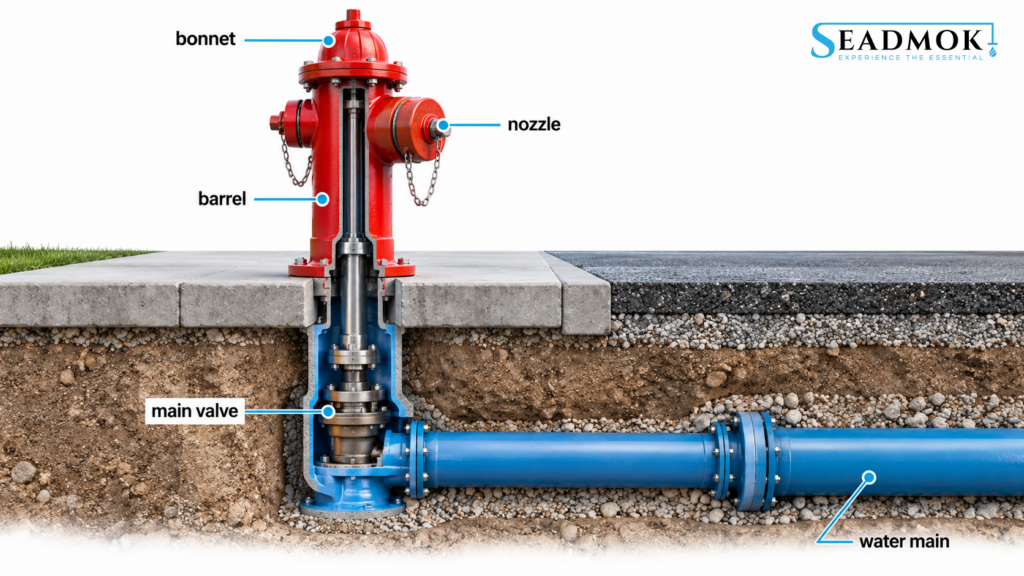
At Seadmok Water Construction L.L.C, we have installed, replaced, and flow tested fire hydrants for more than 10 years across Howard County, Baltimore City, Montgomery, Prince George's, and Anne Arundel Counties. "How do fire hydrants work?" is a question we hear from property managers more often than you might expect, usually right after a fire marshal flags a hydrant on their site.
Here's the 40-second version. A hydrant connects to the underground water main through a short lateral pipe and a shutoff valve. Turning the operating nut on top raises a stem that lifts the main valve at the base. Pressurized water fills the barrel and exits through the nozzles where hoses attach.
First, here is the full sequence at a glance:
| Stage | What Happens Inside the Hydrant | Where the Water Is |
|---|---|---|
| Closed | Main valve seated, drain holes open | In the main, below the frost line |
| Opening | Operating nut turns the stem, main valve lifts, drain holes seal | Rising up the barrel |
| Flowing | Main pressure pushes water out the open nozzles | Barrel and supply hose |
| Closing and draining | Main valve reseats, drain holes reopen, barrel empties | Back below ground |
That table covers a dry barrel hydrant, the type used across Maryland; the sections below explain each part, where the water comes from, and where hydrants fail.
We'll be straight with you: most hydrant failures we see across Howard County and Baltimore are not dramatic. They are seized operating nuts, clogged drain holes, and caps rusted shut. Knowing how the parts fit together is the first step to catching those problems early.
A hydrant is a valve, not a pump or a storage tank. Before asking how much water a hydrant can deliver, ask what size main it sits on and how much pressure that main carries. The hydrant's capacity is really the main's capacity.
Where Does Fire Hydrant Water Come From?
Fire hydrant water comes from the same municipal water main that feeds the homes and businesses on that street.
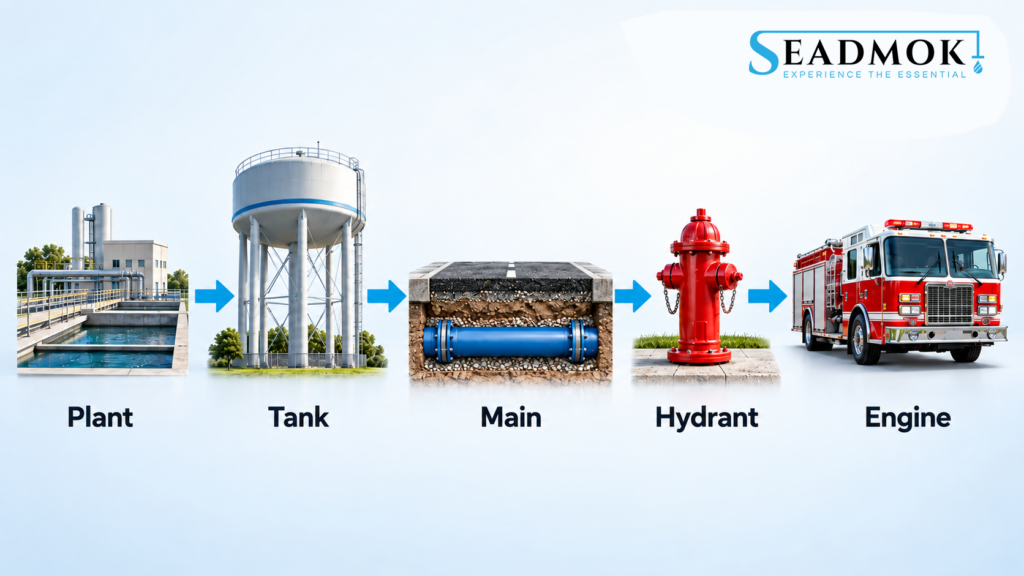
Think of the main as a highway and the hydrant as an on-ramp: the ramp does not create traffic, it just gives you access to whatever is already moving.
The distribution system does all the work. Water treatment plants, storage tanks, and pumping stations keep the mains pressurized around the clock, typically somewhere near 50 psi at the hydrant, although the figure varies with elevation and the size of the main, according to Wikipedia's overview of fire hydrants. The hydrant simply opens a door into that system.
That is why a hydrant on a 6 inch main in a dense commercial block can outperform one on a 4 inch dead-end line in a subdivision.
When we install or replace a water main and its valves, the hydrant lateral is tied in at the same time.
Fire engines add muscle. A pumper connects to the hydrant, draws whatever the main provides, and uses its onboard pump to boost pressure and split the supply into multiple hose lines.
What Are the Parts of a Fire Hydrant?
The main fire hydrant parts are the bonnet, operating nut, nozzles, barrel, stem, and main valve, plus a shoe at the base that bolts to the lateral pipe. Everything you can see on the sidewalk is roughly half of the hydrant. The rest is buried.
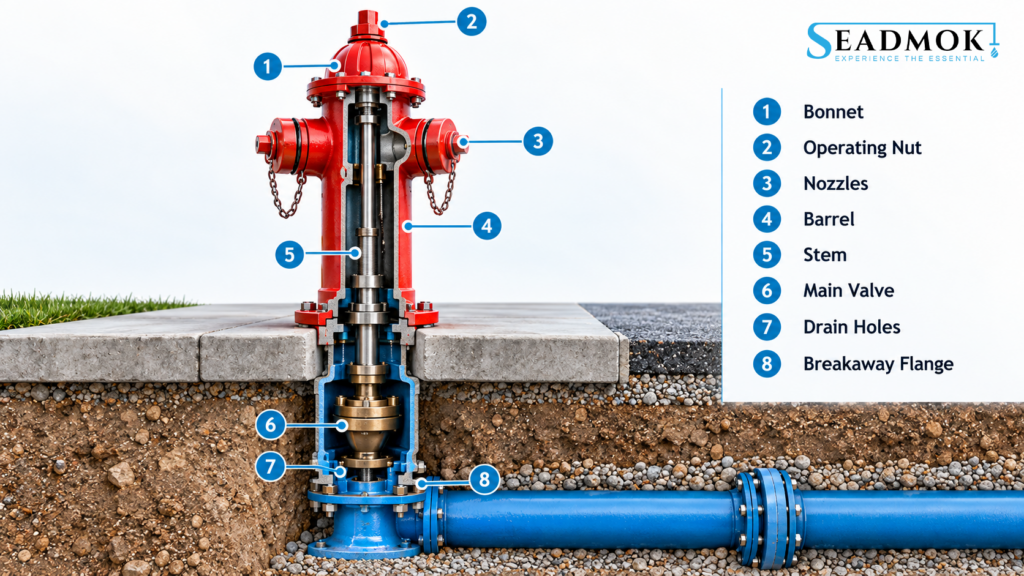
- Bonnet: the cap on top that houses the operating mechanism. It is usually painted to show flow class.
- Operating nut: the five-sided nut on the bonnet. It is pentagonal on purpose, so an ordinary wrench cannot open it.
- Nozzles (outlets): two 2.5 inch hose outlets and one larger 4.5 inch "steamer" outlet on a typical US hydrant. Threaded caps keep debris out.
- Barrel: the vertical cast iron body. It houses the stem and carries water upward once the valve opens.
- Stem: the long rod running from the operating nut down to the valve.
- Main valve: the shutoff at the base. On a dry barrel hydrant it sits below the frost line.
- Drain (weep) holes: small ports at the base that empty the barrel after use.
- Breakaway flange: a sacrificial joint near ground level. If a vehicle hits the hydrant, the flange snaps and the valve below stays shut.
The steamer outlet name is a leftover from the days when hydrants fed steam-powered pumpers. The first cast iron hydrant was patented in 1801 by Frederick Graff, chief engineer of the Philadelphia Water Works, and the basic layout has barely changed since.
Dry Barrel vs. Wet Barrel Hydrant: Which Type Do You Have?
The difference between a dry barrel and a wet barrel hydrant is where the water sits when nobody is using it. A dry barrel hydrant keeps water below ground until it is opened. A wet barrel hydrant is full of water all the time, right up to the nozzles.
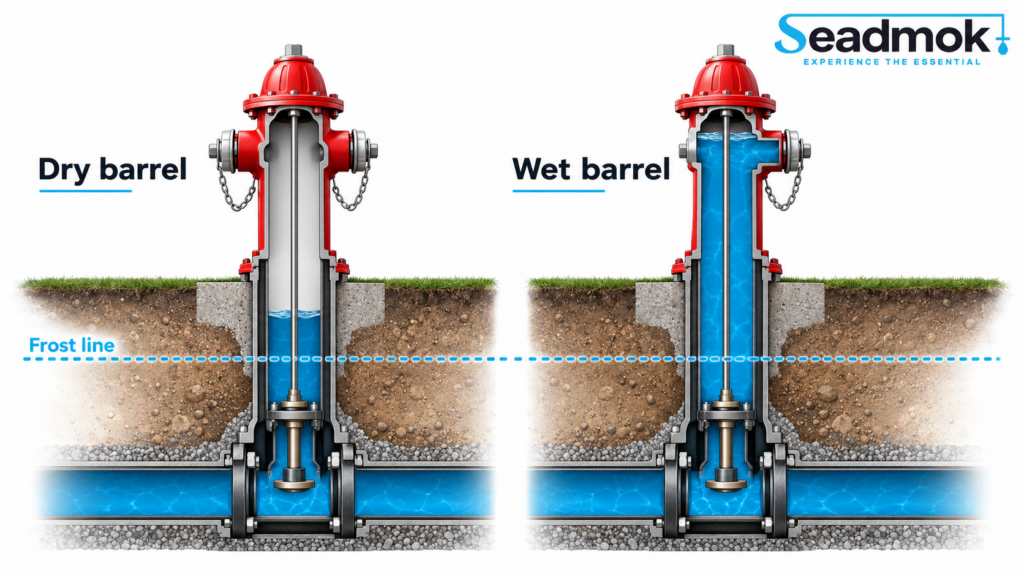
If you are in Maryland, you almost certainly have dry barrel hydrants. Winters here freeze the ground, and a barrel full of standing water would crack the first hard night in January.
The AWWA C502 standard for dry barrel fire hydrants covers exactly this design: a valve at the base, a stem to lift it, and a barrel that drains itself.
| Feature | Dry Barrel Hydrant | Wet Barrel Hydrant |
|---|---|---|
| Where the water sits at rest | Below the frost line, in the main | Inside the barrel at all times |
| Main valve location | At the base, underground | At each nozzle, above ground |
| Climate | Freezing climates (Maryland, Northeast, Midwest) | Frost-free climates (Southern California, Florida) |
| Outlets | One stem opens all outlets together | Each outlet has its own valve |
| Drainage after use | Automatic through drain holes | Not needed |
| Governing standard | AWWA C502 | AWWA C503 |
The trade-off is control. A wet barrel hydrant lets a crew open one outlet at a time. A dry barrel hydrant opens everything at once, so firefighters usually add gate valves to the outlets before charging the line.
How Does a Fire Hydrant Work Step by Step?
A fire hydrant works by lifting a buried valve so system pressure can push water up the barrel and out the nozzles.
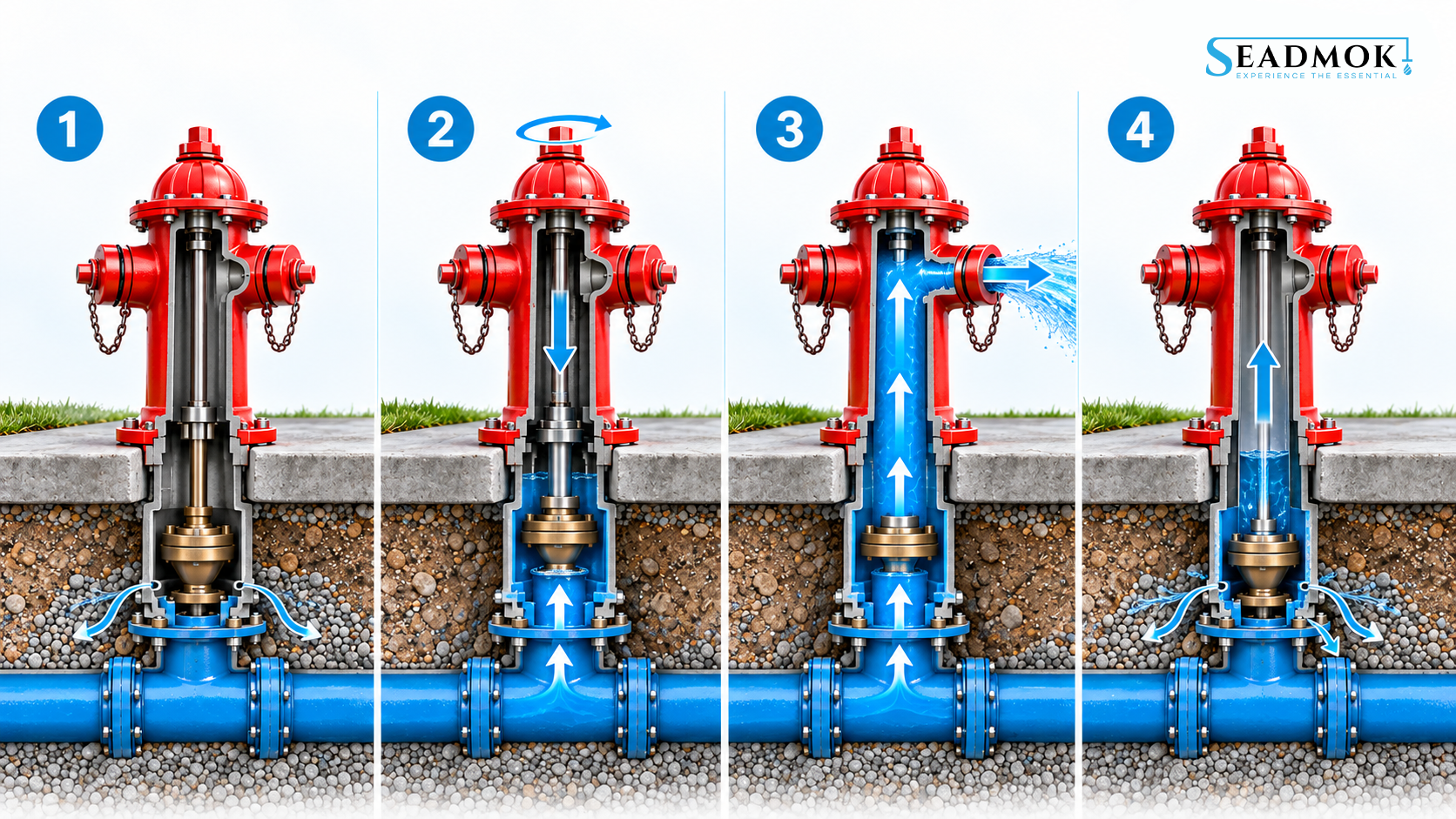
Here is the sequence a crew follows, and what happens inside the hydrant at each step:
- Remove the nozzle cap. The crew pulls the cap from the outlet they need, usually the large steamer port for the supply line.
- Attach the hose or gate valve. Supply hose threads or clamps onto the nozzle. Many departments fit a gate valve here first for control.
- Turn the operating nut slowly. A hydrant wrench rotates the pentagonal nut, which turns the stem.
- The main valve lifts. The stem raises the valve off its seat at the base. On a dry barrel hydrant, this also closes the drain holes so water cannot escape into the soil.
- The barrel fills. Water rushes up under main pressure and out through the open nozzle into the hose.
- Close fully and let it drain. After the fire, the crew closes the nut all the way. The main valve seats, the drain holes reopen, and the barrel empties into a gravel bed around the shoe.
A hydrant is built to run fully open or fully closed. Most hydrant valves are not designed to throttle, and running one half open sends water straight out the drain holes and washes away the soil holding the hydrant in place. Open and close slowly, too: a fast turn causes water hammer, a pressure spike that can crack pipe joints down the street.
That gravel bed matters more than people think. When our crew replaced three aging 6 inch hydrants for a business in Capitol Heights, we backfilled to a 2 ft depth with Class 57 gravel over the weep and drain holes before stabilizing and seeding the site. Skip that step and the barrel holds water, freezes, and fails.
How Much Water Does a Fire Hydrant Put Out?
A fire hydrant can put out anywhere from under 500 GPM to well over 1,500 GPM, depending on the main behind it.

According to the Autodesk One Water Blog (January 2025), the highest-capacity hydrants can fill a backyard swimming pool in a few minutes.
The deciding factors are system pressure, pipe size and condition, nearby demand, and elevation. None of them live inside the hydrant.
Pressure vs. Flow: Two Different Numbers
Fire hydrant water pressure and fire hydrant GPM are two different numbers, and both get measured:
- Static pressure: what the gauge reads with the hydrant closed.
- Residual pressure: what remains while water is flowing.
- Flow (GPM): calculated from the pitot reading at the open nozzle.
Residual pressure should stay above roughly 20 psi during a flow test. Below that, mains can draw in contaminants, which is one reason boil water advisories follow big fires.
NFPA 291 Flow Classes and Colors
NFPA 291, the recommended practice for water flow testing and marking of hydrants, uses those results to sort hydrants into four classes. The 2022 edition applies to both public and private hydrants. Most utilities paint the bonnet and caps to match the class, with the barrel left chrome yellow.
| Class | Rated Flow | Cap and Bonnet Color | What It Tells the Crew |
|---|---|---|---|
| AA | 1,500 GPM or more | Light blue | Very high capacity, supply line hydrant |
| A | 1,000 to 1,499 GPM | Green | Good capacity for most residential fires |
| B | 500 to 999 GPM | Orange | Marginal, plan for a second hydrant |
| C | Under 500 GPM | Red | Low capacity, consider another source |
Not every Maryland jurisdiction follows the NFPA color scheme, so a red hydrant in one town may just be the local paint choice.
For a look at how we run a flow test on a private site, our complete fire hydrant repair and maintenance guide walks through the gauges, the pitot, and the math.
Who Keeps a Hydrant Working, and What Goes Wrong?
Responsibility for a fire hydrant depends on where it stands: the water utility maintains public street hydrants, and the property owner maintains hydrants on private land.
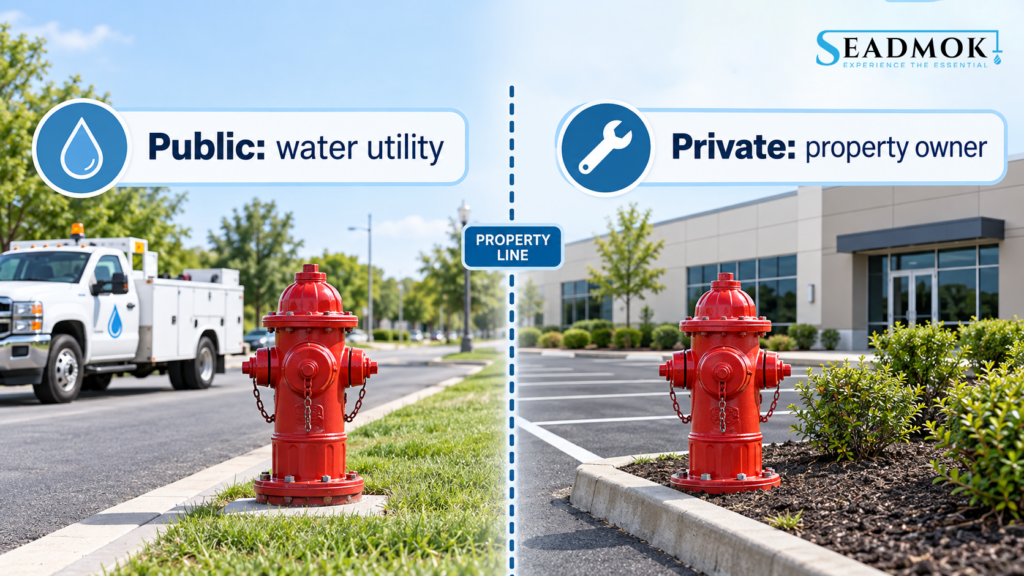
Public vs. Private Hydrants
Here is the split in plain terms:
- Public hydrant: inspected and maintained by the water utility, such as WSSC Water, Baltimore City DPW, or Howard County's Bureau of Utilities.
- Private hydrant: parking lots, apartment complexes, campuses, and industrial yards. The owner is responsible, and municipal crews typically skip them.
That is where most of our hydrant work comes from. A private hydrant on a shopping center pad or a warehouse yard may go a decade without being opened. In that time the operating nut seizes, the caps corrode onto the threads, and sediment packs the drain holes. Then the fire marshal arrives.
What a Basic Annual Maintenance Program Covers
A basic annual program is short:
- Operate the valve fully open and fully closed
- Flush the barrel
- Grease the operating nut and caps
- Replace worn gaskets
- Check that the drain holes still weep
Our Montgomery County hydrant maintenance guide lays out a typical yearly schedule. If your hydrants have never been flow tested, our fire hydrant preventive maintenance service starts there.
One honest limitation: a flow test tells you what the main can deliver at that hydrant on that day. It does not guarantee the hydrant itself will open cleanly under a crew's wrench two winters from now. That part only comes from operating it regularly.
Bottom Line
A fire hydrant is the simplest part of the fire protection chain and the one most people misunderstand. It does not make water pressure. It borrows it from the main, through a valve that is either open or shut, and then quietly drains itself so it survives a Maryland winter.
If the hydrant serves a public street, the utility has it covered. If it stands on your property, it is yours. Open it once a year, grease it, flush it, and get it flow tested so the number on the bonnet means something.
A fire hydrant is a valve on the water main, not a pump. Most Maryland hydrants are dry barrel units that drain themselves after every use. It runs fully open or fully closed, and if it sits on private property, testing and maintenance are the owner's job.
Seadmok Water Construction LLC has installed, replaced, and flow tested hydrants across Howard County, Baltimore City, Montgomery, Prince George's, and Anne Arundel Counties. If you are not sure who owns the hydrant outside your building, or when it was last opened, contact our team and we will find out with you.
Frequently Asked Questions
How does a fire hydrant connect to the water supply?
A hydrant connects to the water main through a short lateral pipe, usually 6 inches in diameter, with an isolation gate valve between the two. The hydrant shoe bolts to the end of that lateral. That isolation valve lets a crew shut off and replace one hydrant without depressurizing the whole main.
Why are fire hydrants not full of water?
In freezing climates, hydrants are not full of water because standing water in the barrel would freeze and split the cast iron. Dry barrel hydrants keep the main valve below the frost line and drain the barrel through weep holes each time they close. Wet barrel hydrants in frost-free regions stay full because freezing is not a concern.
What is the purpose of the drain holes on a fire hydrant?
Drain holes let a dry barrel hydrant empty itself after use so nothing is left inside to freeze. They open automatically when the main valve closes and seal when it opens. If they clog with sediment or the gravel bed around them silts up, water sits in the barrel and the hydrant can fail in winter.
Why is the operating nut on a fire hydrant pentagonal?
The operating nut is five-sided so that a standard wrench or pliers cannot turn it. Only a dedicated hydrant wrench fits, which discourages unauthorized use. Opening a hydrant without permission is illegal in most jurisdictions because it wastes treated water and drops pressure for firefighters and neighbors.
How much water does a fire hydrant put out per minute?
Typical US hydrants deliver between 500 and 1,500 GPM, with the strongest supply hydrants exceeding 1,500 GPM. The exact figure depends on the water main, not the hydrant, which is why two identical hydrants a block apart can test very differently. A flow test under NFPA 291 is the only way to know your number.
Who is responsible for a fire hydrant on private property?
The property owner is responsible for hydrants located on private land, such as parking lots, apartment complexes, campuses, and industrial sites. Water utilities inspect public street hydrants but generally do not maintain private ones. Owners usually hire a licensed contractor like Seadmok Water Construction for annual inspection, flow testing, and repairs.
