

Fire Hydrant Replacement: What to Plan Before the Crew Arrives
Last Updated: November 10, 2026
What you need to know about fire hydrant replacement
- Fire hydrant replacement means removing a failing hydrant and setting a new one, with the gate valve and hydrant lead checked underneath.
- Replace a hydrant that is cracked, badly corroded, obsolete or leaking again after repairs. Repair usually wins when the barrel is sound and parts exist.
- The work runs in four stages: assessment, excavation and removal, installation and drainage, then a pressure test and site restoration.
- Cost depends on hydrant size, depth, gate valve condition and the surface to restore, so expect a site-specific quote.
- Before the crew arrives, call Miss Utility, plan the shutoff and know who owns the inspection duty afterward.
Fire hydrant replacement means taking out a worn, damaged or obsolete hydrant and setting a new one in its place, with a check of the gate valve and hydrant lead below it. It sounds like a one-day swap. The planning around it decides whether it goes smoothly.
At Seadmok Water Construction we provide fire hydrant services across Maryland, so this page is the planning view. We'd say up front that replacing a failing hydrant beats patching it a third time. If you want the service details, see our fire hydrant replacement service.
What Is Fire Hydrant Replacement?
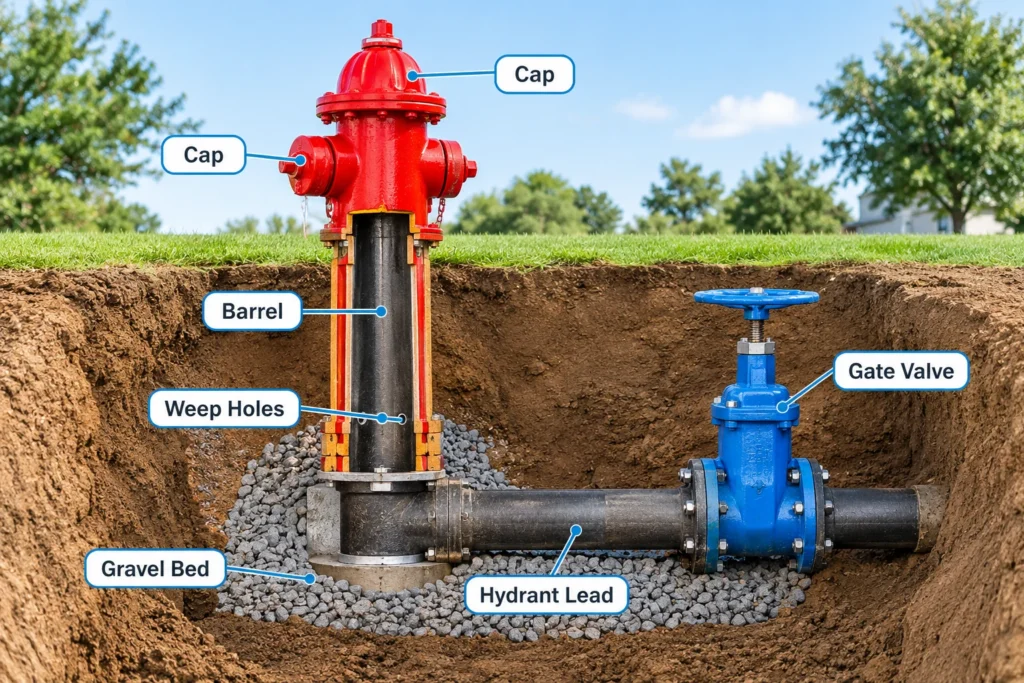
Fire hydrant replacement is the full swap of a hydrant: the old unit comes out, a new one goes in, and the connection beneath it is checked and tested. Repair fixes a part. Replacement changes the whole hydrant, like buying a new tire instead of patching the same one again.
Most people only see the barrel and the caps. Underneath sit the gate valve (the valve that lets crews shut the hydrant off from its supply) and the hydrant lead (the short pipe that connects the hydrant to the supply line). A new hydrant on a failing valve is only half a fix, so both get checked.
When to Replace a Fire Hydrant Instead of Repairing It
When to replace a fire hydrant comes down to two questions: is the barrel sound, and can you still buy the parts? If the answer to either is no, replacement is usually the better route. These are the signs we see most:
- Repeated leaks or valve failures: if the same hydrant keeps landing on the repair list, the fixes are not holding.
- An obsolete model with no replacement parts: even a small repair becomes impossible.
- A cracked barrel or severe corrosion: structural damage is not something you can swap out.
Age alone does not condemn a hydrant, since many last 50 years or more. Still, old fleets add up. UC Davis Facilities says 90 of its 450 campus hydrants were more than five decades old when it began a replacement program.
Repair can also win by a wide margin. The City of Cedar Rapids says a replacement averages about $5,500 while a rebuild runs around $500, so it rebuilds when it can.
| Situation | Better Route | Why |
|---|---|---|
| Worn gasket or leaking cap | Repair | Small part, sound barrel |
| Valve seat that can be removed and rebuilt | Repair | Quicker and cheaper than a new hydrant |
| Cracked barrel | Replace | A crack is structural, not a part |
| Obsolete model, no parts available | Replace | The part cannot be bought |
| Leaking again after repairs | Replace | The repairs are not holding |
Our guide to fire hydrant repair and maintenance lists the warning signs in more detail. Our fire hydrant repair service page covers what we fix without replacing.
What Is the Fire Hydrant Replacement Process?
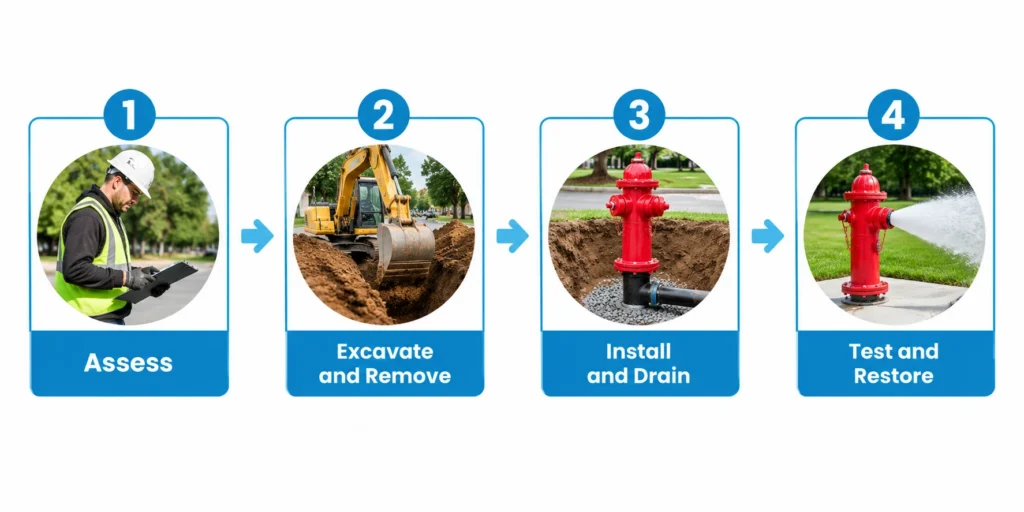
The fire hydrant replacement process runs in four stages: assessment, excavation and removal, installation and drainage, then a pressure test and restoration.
- Assessment and planning. Technicians operate the hydrant, check whether parts are still available, and inspect the gate valve and hydrant lead. Only then do they recommend repair or replacement.
- Excavation and removal. The crew locates underground utilities, digs and shores the area, exposes the lead and valve, and removes the old hydrant. The aim is to keep disruption low.
- Installation and drainage. The new hydrant is set plumb at the correct depth and connected to the lead, with a new gate valve where one is needed. Class 57 gravel goes over the weep holes (small drain openings at the base) so the barrel can drain after use.
- Pressure test and restoration. The connection gets a pressure test, the hydrant is flushed, and the crew checks that it opens, drains and flows. Then the site is restored with sod, seed, asphalt or concrete.
Our Capitol Heights project shows the pattern. A local business needed three aging 6-inch hydrants replaced and compared several firms before choosing us. The crew excavated the old hydrants, installed three new 6-inch units, and backfilled to 2 feet with Class 57 gravel over the weep and drain holes. Then they seeded the area and restored the landscape.
What Should You Decide Before the Crew Arrives?
Decide four things first: who owns the hydrant, which type you need, what size and flow it must match, and who will inspect it afterward.
- Ownership. Public hydrants usually belong to the utility. Private hydrants on a campus, complex or commercial lot belong to the property owner. NFPA's own committee report for NFPA 291 points private hydrant inspection, testing and maintenance to NFPA 25.
- Type. A dry-barrel hydrant (one where the barrel stays empty until the valve opens) is built for climates with freezing temperatures, which includes Maryland. AWWA C502 covers dry-barrel hydrants for fire protection, while AWWA C503 covers wet-barrel hydrants for mild climates.
- Size. Confirm the size of the hydrant you have and the connection beneath it. Our Capitol Heights replacements were 6-inch hydrants.
- Flow class. NFPA 291 groups hydrants by flow, from Class C (up to about 500 gallons per minute) to Class AA (over 1,500), according to Angi's summary. That is why marking gets checked after a new hydrant is flow tested.
One more detail worth knowing: AWWA C502 sets requirements for the hydrant itself, not for installing it. Installation, field testing and maintenance guidance sits in AWWA C600 and AWWA Manual M17, according to the standard's own scope notes. The current edition of C502 is C502-24, per AWWA's store listing.
What Affects Fire Hydrant Replacement Cost?
Fire hydrant replacement cost depends on four things: hydrant size, burial depth, the condition of the gate valve, and the surface that has to be restored afterward. We price against those, so quotes come after a look at the site, not before.
- Hydrant size: a 6-inch unit and a smaller one are not the same job.
- Depth: a deeper bury means more digging, shoring and gravel.
- Gate valve condition: a failing valve adds work, because it has to be replaced too.
- Surface restoration: sod and seed cost less to restore than asphalt or concrete.
For rough orientation only, Angi's 2026 cost data puts private fire hydrant installation at about $3,000 to $9,100, averaging near $6,500. That is a new-installation range, not a replacement quote. The City of Cedar Rapids figure above is another ballpark. Costs vary a lot by site, so treat every outside number as a starting point.
How Do You Prepare a Site for Fire Hydrant Replacement?
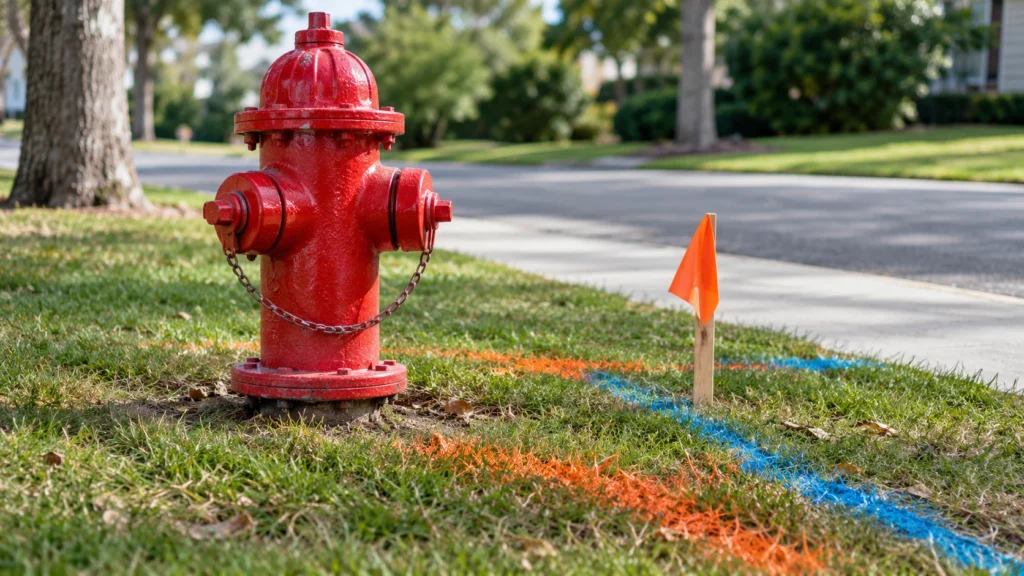
Preparing a site means confirming where underground lines run, clearing room for the crew, and agreeing on a shutoff plan before digging starts.
- Call Miss Utility. Maryland's one-call center asks for notice at least three full business days before excavation, according to missutility.net as checked in November 2026.
- Expect hand digging near the marks. Maryland law requires hand digging 18 inches on each side of marked utility lines to expose them, per Miss Utility.
- Plan the shutoff. Shutoffs are usually brief. An auxiliary gate valve can isolate the hydrant without shutting off the supply line, and we coordinate timing with the customer and the utility.
- Decide the finish. Tell the crew whether the area should return to sod, seed, asphalt or concrete.
Some older pages still say Miss Utility needs only two days of notice. Plan for three full business days, and confirm who is placing the request so it does not get missed.
What Happens After the New Hydrant Is In?
Once the new hydrant is set, it is pressure tested, flushed and flow checked, and the work is documented for your records. Think of it as a road test before handing over the keys.
Private owners then fold the hydrant into their inspection program. NFPA 25 covers inspection, testing and maintenance of private hydrants, and NFPA 291 covers flow testing and color marking.
Your local fire department may add its own marking rules, so ask before repainting a new hydrant.
Our post on fire hydrant color codes explains what the colors mean. Our fire hydrant preventative maintenance service keeps a new hydrant in shape. And if a hydrant has already failed in the street, what to do about a burst fire hydrant covers the first steps.
Who Needs Fire Hydrant Replacement Services?
Anyone who owns or manages a hydrant that is aging, leaking or beyond repair. In our work that means businesses, campuses, HOAs and developers across Maryland.
If the equipment is new to you, start with how fire hydrants work. It makes the rest of this page easier to follow.
The Bottom Line
Fire hydrant replacement is a planned job when you catch it early and a scramble when you don't. Know whether the hydrant should be repaired or replaced, line up the utility location and the shutoff, and decide who inspects it afterward. That order saves the most time.
Have a hydrant that is leaking, cracked or out of parts? Contact us and we'll talk through what it needs.
Repair when the barrel is sound and parts exist; replace when the hydrant is cracked, obsolete or leaking again. Then plan the Miss Utility call, the shutoff and the inspection duty before the crew arrives.
Seadmok Water Construction LLC assesses, repairs, replaces and maintains fire hydrants for businesses, campuses, HOAs and developers across Howard County, Baltimore City, Montgomery, Prince George's, and Anne Arundel Counties. If you are not sure whether your hydrant needs a repair or a full replacement, contact our team and we will find out together.
Frequently Asked Questions
How long do fire hydrants last?
Many fire hydrants last 50 years or more, but age alone is not the trigger. Obsolete parts, repeated leaks, a cracked barrel or severe corrosion can justify replacing one much sooner. UC Davis Facilities reports that 90 of its 450 campus hydrants were over five decades old when it began replacing them. Decide by condition, not the calendar.
How much does fire hydrant replacement cost?
It depends on hydrant size, depth, gate valve condition and the surface being restored, so we quote each site individually. For rough orientation, Angi's 2026 data puts private hydrant installation between about $3,000 and $9,100. The City of Cedar Rapids says its replacements average around $5,500 versus about $500 for a rebuild. Treat all of these as ballpark figures.
Should you repair or replace a fire hydrant?
Repair is usually cheaper when parts are available and the barrel is sound. Replace when the hydrant is obsolete, cracked, badly corroded or leaking again after repairs. Our technicians operate the hydrant, check parts availability and inspect the gate valve and hydrant lead before recommending either. If you are unsure, get that assessment first.
Will water be shut off during a fire hydrant replacement?
Usually only briefly. An auxiliary gate valve lets the crew isolate the hydrant without shutting off the supply line, and shutdowns are coordinated with the customer and the utility. Ask about the shutoff plan before work starts so nobody is surprised. Timing depends on the site, so confirm it when you request a quote.
Do you replace commercial and 6-inch fire hydrants?
Yes. We handle hydrant replacement for businesses, campuses, HOAs and developers in several Maryland counties, and 6-inch hydrants are replaced regularly. Our Capitol Heights project swapped three aging 6-inch hydrants for a local business. Send us the location and the hydrant's condition, and we'll arrange an assessment.