

Fire Hydrant Color Codes Explained: What Each Color Means
Table of Contents
- What Do Fire Hydrant Colors Mean?
- What Each Cap Color Means: Blue, Green, Orange, and Red
- What Does a Yellow Fire Hydrant Mean?
- Who Decides Fire Hydrant Colors, and Why Do They Vary by Town?
- How Does a Hydrant earn its color? The flow test behind the paint
- What Hydrant Colors Cannot Tell You
- Bottom Line
- Frequently Asked Questions
Last Updated: October 16, 2026
TL;DR: fire hydrant color codes in 30 seconds
- The color on the top (bonnet) and nozzle caps tells firefighters how much water the hydrant can deliver. Under NFPA 291: light blue is 1,500 GPM or more, green is 1,000 to 1,499 GPM, orange is 500 to 999 GPM, and red is under 500 GPM.
- The barrel color usually tells you who owns the hydrant or what water it carries. Chrome yellow is the recommended color for public hydrants, red for private hydrants on public streets, and purple or violet for non-potable water.
- NFPA 291 is a recommended practice, not a law. Your water utility or fire department can adopt it, modify it, or use its own chart, so always check the local scheme.
- The color reflects the water main behind the hydrant, not the hydrant itself. A blue cap on a seized, unmaintained hydrant is a promise the hydrant cannot keep.
- If the hydrant sits on your property, you are responsible for testing it, maintaining it and keeping the color accurate.
What Do Fire Hydrant Colors Mean?

Fire hydrant colors are a flow rating system: the paint on the top and caps tells firefighters how much water a hydrant can deliver before a single hose is unrolled.
At Seadmok Water Construction L.L.C, we have flow tested, maintained, and replaced fire hydrants for more than 10 years on commercial and institutional sites across Maryland. This question comes up on almost every site walk, usually right after a property manager notices the hydrant by the loading dock is painted differently from the ones on the street.
The short version: fire hydrant color codes are a flow rating system. They are the fastest piece of information a fire crew gets when they pull up to a burning building.
Here's the one-paragraph answer. Fire hydrant color codes work in two layers: the bonnet and cap color show the hydrant's flow class in gallons per minute under NFPA 291, and the barrel color shows ownership or water source (yellow for public, red for private, purple for non-potable). Local utilities can and do change the scheme.
We'll say this up front: we've replaced hydrants that wore a confident green cap and had not been opened in years. The paint was fine. The valve was not. Keep that in mind as you read the chart.
First, here is the cap color code at a glance:
| Class | Rated Flow | Bonnet and Cap Color | What It Tells the Crew |
|---|---|---|---|
| Class AA | 1,500 GPM or more | Light blue | High capacity, can supply a large fire or multiple engines |
| Class A | 1,000-1,499 GPM | Green | Good capacity for most structure fires |
| Class B | 500-999 GPM | Orange | Limited, plan a second hydrant for anything large |
| Class C | Under 500 GPM | Red | Low capacity, suitable for small fires only |
That table covers the flow colors; the barrel is a separate layer (yellow for public, red for private, purple for non-potable), and the sections below explain both.
Caps vs. Barrel: The Two Color Layers
Fire hydrant colors mean two different things depending on where the paint is. The bonnet and nozzle caps are a flow classification. The barrel is an ownership and water source marker.
Both layers come from NFPA 291, the Recommended Practice for Fire Flow Testing and Marking of Hydrants, published by the National Fire Protection Association.
Think of it like a traffic light bolted to a water main. The cap answers the crew's first question: how much water can this hydrant give? The barrel answers the second: whose hydrant is it, and is the water safe?
NFPA 291 sorts hydrants into four classes based on the flow available at 20 psi residual pressure. The American Water Works Association recommends the same color scheme, which is why both water utilities and fire departments use it. The Pennsylvania Department of Environmental Protection reproduces the AWWA chart and adds the test condition: ratings assume 20 psi residual pressure when static pressure is over 40 psi.
NFPA 291 is a recommended practice, not a law. Your water utility or fire department can adopt it, modify it, or run its own chart. Before you read a cap color as a flow guarantee, confirm which scheme your local system uses.
What Each Cap Color Means: Blue, Green, Orange, and Red

The cap color is the part of the fire hydrant color code that matters most on a fire scene. The four colors below follow NFPA 291 and the AWWA recommendation. Where your town differs, the local chart wins.
Blue Fire Hydrant Meaning
A light blue bonnet or cap means Class AA, a rated flow of 1,500 GPM or more. This is the hydrant a crew wants for a warehouse, an apartment block, or anything that will need more than one engine drawing supply.
Blue caps almost always sit on larger mains, 12 inch and up, in commercial corridors or newer developments. The blue is not about the hydrant. It is about the pipe under the street.
When we tie a new hydrant lateral into a water main for a developer, the flow class is decided by that main's size and pressure before the hydrant is even delivered.
Green Fire Hydrant Meaning
A green cap means Class A, 1,000 to 1,499 GPM. In most Maryland suburbs this is the workhorse hydrant: enough flow for a two-story home or a small commercial building without a second supply line.
Green also fades toward yellow-green after a decade of sun, which is why repainting is part of a proper maintenance cycle, not a cosmetic extra.
Orange Fire Hydrant Meaning
An orange cap means Class B, 500 to 999 GPM. Crews treat orange as a caution flag: fine for a vehicle fire or a small residential job, but they identify a second hydrant early in case the fire grows.
Red Fire Hydrant Meaning
A red cap means Class C, under 500 GPM. NFPA considers this capacity inadequate for most structure fires. Red caps show up on older dead-end mains, small-diameter pipes in mid-century neighborhoods, and the far ends of long distribution runs where pressure drops.
Here is where red gets confusing. A red barrel can mean something completely different (a private hydrant, covered below), and some towns paint entire hydrants red for visibility with no flow meaning at all. Only the local chart tells you which.
How crews read the caps:
- Blue: hook up and go, enough for multiple engines
- Green: enough for most homes and small commercial buildings
- Orange: usable, but find a second hydrant early
- Red: small fires only, plan another water source
What Does a Yellow Fire Hydrant Mean?
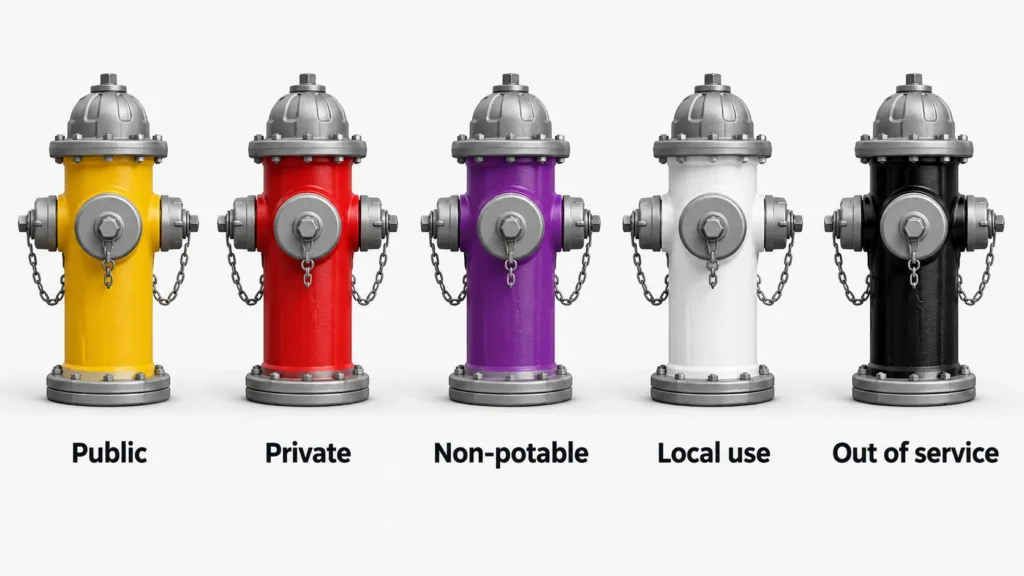
A yellow fire hydrant, specifically a chrome yellow barrel, means a public hydrant on a municipal water system. NFPA 291 recommends chrome yellow for all public hydrant barrels unless a jurisdiction has already adopted another color, and it recommends reflective paint so the hydrant is visible at night.
So yellow is not a flow rating. It is the default background that the colored cap sits on. The barrel colors you will see most often:
- Chrome yellow: public hydrant on a municipal system. The NFPA and AWWA default.
- Red barrel: private hydrant located on a public street. NFPA 291 recommends red or another contrasting color so crews can tell it apart from the public system.
- Purple or violet: non-potable water, usually from a reclaimed or recycled water system. Purple marks non-potable supply on pipes, valve boxes, and hydrants alike.
- White or silver: adopted locally in some systems, sometimes for visibility, sometimes to mark a dead-end main. No national meaning.
- Black: used in a few states to mark a hydrant that is out of service. NFPA 291 does not assign black; it recommends removing permanently dead hydrants and bagging or wrapping temporarily inoperative ones.
If you see a bag over a hydrant in Howard County or Baltimore, that is the temporary out-of-service marker in action. It usually means the utility or the owner has a repair pending.
Who Decides Fire Hydrant Colors, and Why Do They Vary by Town?

The water utility that owns the hydrant decides the color, and the fire department that uses it decides whether the colors are worth trusting. Neither is bound by NFPA 291, because it is a recommended practice rather than a code. A jurisdiction has to adopt it for the chart to carry any weight.
That is why NFPA 291 hydrant colors are consistent on paper and inconsistent on the street. In practice, you get three situations:
- Full adoption: the utility flow tests every hydrant, paints bonnet and caps to the NFPA class, and keeps barrels chrome yellow. Most larger utilities in the Mid-Atlantic lean this way.
- Partial adoption: the flow colors follow NFPA, but the barrel colors follow local history. A town that has painted hydrants red for sixty years is not repainting them all yellow.
- Local scheme: some cities run their own chart, with different colors, different breakpoints, or extra markings like arrows for dead-end mains and a circled R for regulated pressure zones.
In our service area, a hydrant in Columbia, one in Baltimore City, and one in Silver Spring can each follow a slightly different convention, because they sit on three different water systems. Before you read a cap color as a flow guarantee, confirm which chart that system uses. Our Montgomery County hydrant maintenance guide covers what to ask your utility about its marking scheme.
How ISO Uses Hydrant Colors
There is a third party watching the colors. The Insurance Services Office (ISO) grades every fire protection area on a 1 to 10 Public Protection Classification scale, and water supply makes up 40 percent of that score.
ISO relies on AWWA guidance for hydrant criteria and observes hydrant flow tests directly. Accurate colors on tested hydrants are part of the evidence that lowers a community's rating and, in turn, insurance premiums.
How Does a Hydrant earn its color? The flow test behind the paint
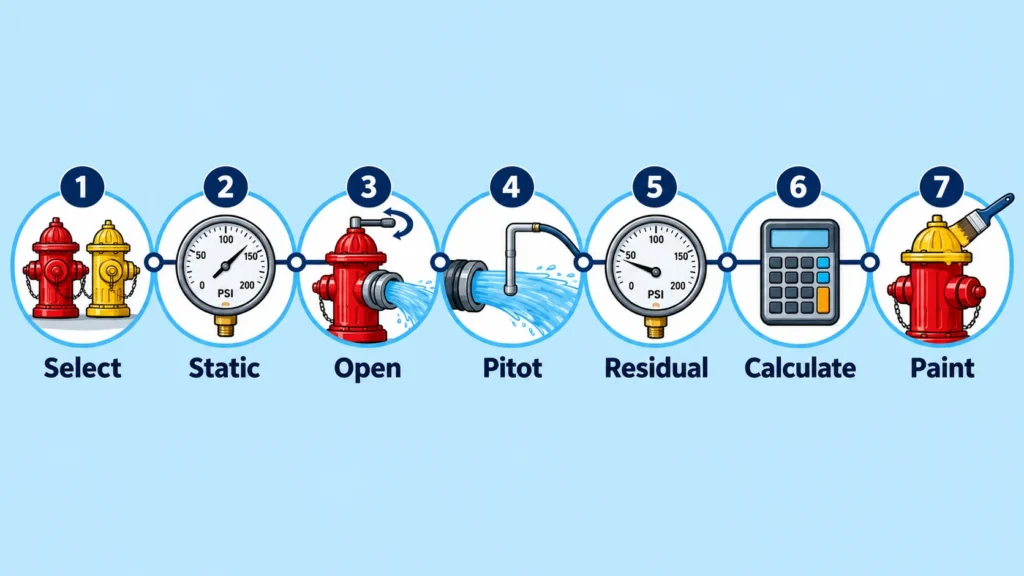
A hydrant earns its cap color through a flow test, and no reputable utility or contractor paints a class on a hydrant it has not measured. The procedure comes straight from NFPA 291.
Here is the sequence we follow on a private site:
- Pick the test and flow hydrants. The gauge goes on one hydrant (the test hydrant); water flows from a neighboring one on the same main.
- Record static pressure. With nothing flowing, the gauge shows the resting pressure in the main.
- Open the flow hydrant fully. Slowly, to avoid water hammer, and all the way, so the drain holes seal.
- Read the pitot pressure. A pitot gauge held in the stream gives the velocity pressure, which converts to GPM using the nozzle size and a discharge coefficient.
- Record residual pressure. While water is still flowing, read the test hydrant gauge again. This is the number that matters.
- Calculate available flow at 20 psi residual. The readings are projected to find how many GPM the main can deliver while holding 20 psi, the floor that keeps contaminants from being drawn into the system.
- Assign the class and paint. The projected GPM lands in AA, A, B, or C, and the bonnet and caps get that color in reflective paint.
Two extra NFPA 291 markings come out of the same test. A hydrant that cannot hold 20 psi gets its actual rated pressure stenciled in black on the top. A very high-capacity hydrant can have its rated GPM stenciled as well.
A flow test is a snapshot. It records what the main delivered on that day, with that demand on the system. A main break two streets over, a new subdivision drawing supply, or a closed valve nobody logged can all change the real number. That is why ISO expects retesting on a cycle, and why the paint should never be older than the last test.
What Hydrant Colors Cannot Tell You

Hydrant colors only describe flow and ownership. The paint says nothing about whether the hydrant will open, drain, or seal. Those are maintenance questions, and on private property they are the owner's questions.
We see this most on commercial sites: shopping centers, warehouses, apartment complexes, and campuses. The hydrant in the parking lot was painted when it was installed, and nobody has opened it since.
The operating nut is seized, the caps are rusted onto the threads, and the drain holes are packed with silt. The cap still says green. In practice, the hydrant is a decoration until someone services it.
When our crew replaced three aging 6 inch hydrants for a business in Capitol Heights, the old units looked serviceable from the curb. It took an attempt to operate them to find out they were not. The replacements went in with Class 57 gravel over the drain holes so they would drain through a Maryland winter, and the fire marshal's inspection cleared the site.
Private Hydrants: The Owner's Responsibility
Who keeps the color accurate depends on who owns the hydrant:
- Public hydrant: the water utility (such as WSSC Water or Baltimore City DPW) owns it, tests it, and paints it.
- Private hydrant: the property owner owns it and is responsible for testing, maintenance, and keeping the color accurate, usually through a licensed contractor.
A fire hydrant color code is a claim. Annual operation, flushing, lubrication, and a documented flow test are what back the claim up.
If you own a private hydrant and cannot remember the last time it was opened, our fire hydrant preventive maintenance service starts with a flow test and a frank assessment of whether the color is still accurate. For the full inspection checklist, see our complete guide to fire hydrant repair and maintenance.
Bottom Line
Fire hydrant color codes are a flow rating system painted onto public infrastructure. Cap and bonnet color is the GPM class: blue, green, orange, red, from most to least. Barrel color is ownership and source: yellow public, red private, purple non-potable.
NFPA 291 wrote the chart, AWWA endorsed it, and your local water utility decides how closely to follow it.
The colors are only as good as the last flow test behind them. On a public street, the utility carries that responsibility. On your property, you do.
Read the cap for flow and the barrel for ownership, then check your local chart. A color is only a claim until a recent flow test and regular maintenance back it up.
Seadmok Water Construction LLC flow tests, maintains, repairs, and replaces fire hydrants for commercial and institutional properties across Howard County, Baltimore City, Montgomery, Prince George's, and Anne Arundel Counties. If you are not sure what the color on your hydrant means, or whether it is still accurate, contact our team and we will find out together.
Frequently Asked Questions
What does a blue fire hydrant mean?
A light blue bonnet or cap means Class AA under NFPA 291, rated at 1,500 gallons per minute or more at 20 psi residual pressure. It is the highest flow class and usually sits on a large main in a commercial area. If the whole hydrant is blue, check your local utility's chart.
Why are some fire hydrants red?
A red cap means Class C, a flow under 500 GPM, which NFPA considers inadequate for most structure fires. A red barrel is different: NFPA 291 recommends it for private hydrants on public streets. Some towns paint every hydrant red for visibility, so red can mean low flow, private ownership, or nothing at all.
What does a yellow fire hydrant mean?
A chrome yellow barrel is the NFPA 291 and AWWA default for public hydrants. It does not indicate flow; the colored bonnet and caps on top carry the flow class. Reflective yellow is recommended so the hydrant is easy to spot at night.
What do the colors on top of a fire hydrant mean?
The top (bonnet) and nozzle cap colors are the flow classification: light blue for 1,500 GPM and up, green for 1,000 to 1,499 GPM, orange for 500 to 999 GPM, and red for under 500 GPM. These come from a flow test performed under NFPA 291 and are repainted when the hydrant is retested.
What does a purple fire hydrant mean?
A purple or violet hydrant carries non-potable water, typically from a reclaimed or recycled water system. Purple is the standard marker for non-potable supply across pipes, valves, and hydrants. Crews can use it for firefighting, but it should never be tapped for drinking water or construction water without checking the source.
Who is responsible for painting a fire hydrant?
The owner of the hydrant. For public hydrants, that is the water utility, such as WSSC Water, Baltimore City DPW, or a county bureau of utilities. For private hydrants on commercial property, apartment complexes, or campuses, it is the property owner, who usually hires a licensed contractor to flow test, maintain, and repaint them.