
Accurate Fire Hydrant Flow Testing for Engineers, Builders and Property Owners
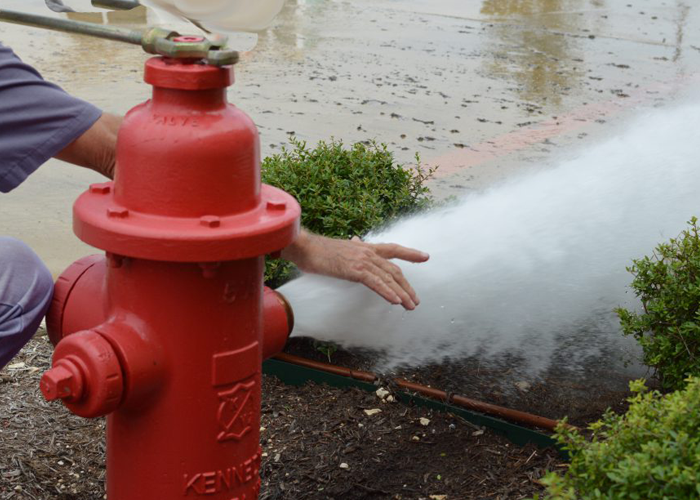
Sprinkler designers, fire marshals and insurers all need the same thing: real numbers for the water supply. A fire flow test gives them static pressure, residual pressure and available flow in gallons per minute at your site. Our crews set up a test hydrant and a flow hydrant on the water main, read flow with a calibrated pitot gauge, and calculate the result at 20 psi residual following NFPA 291.
Contact us today to schedule a hydrant flow test and get the numbers your project needs.
Our hydrant flow testing services include:
- Static pressure and residual pressure readings at the test hydrant
- Flow readings in gallons per minute with a calibrated pitot gauge
- Available fire flow calculated at 20 psi residual
- A signed flow test report with hydrant classification and cap color

Contact Us for Fire Hydrant Flow Testing in and Around Howard County, MD
Waiting on flow data to finish a sprinkler design or a permit? Tell us the address and the hydrants you need tested, and we will schedule the fire hydrant flow test and coordinate with the local water utility.
Services
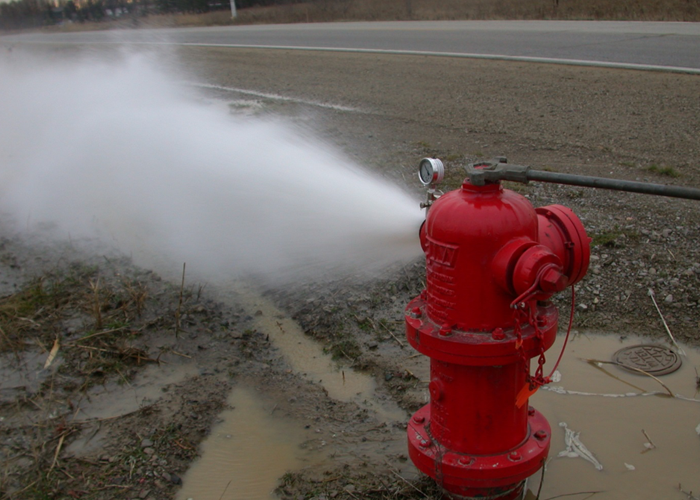
Static and Residual Pressure Testing (PSI)
In a fire hydrant pressure test, we read static pressure at the test hydrant with no water flowing, then read residual pressure while the flow hydrant is open. The drop between the two shows how the main performs under demand.
Why pressure readings matter:
- Sprinkler and standpipe designs depend on them
- Low residual pressure points to main or valve problems
- Documented readings support permit and plan review
Flow Measurement in Gallons per Minute (GPM)
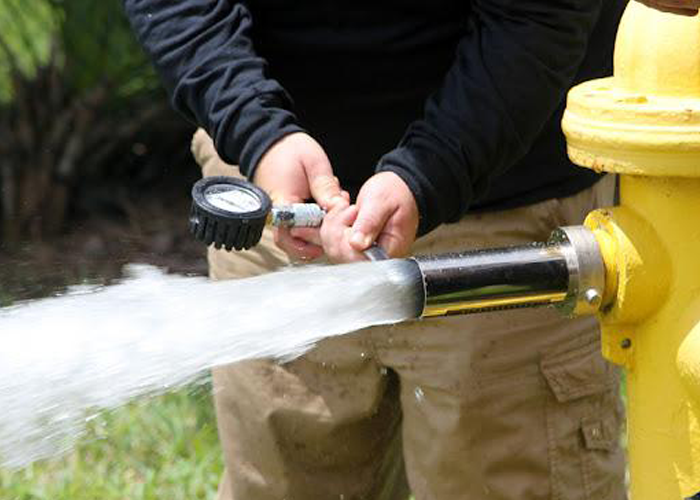
With the flow hydrant open, we take pitot gauge readings at the outlet and convert them to gallons per minute, then calculate the flow available at 20 psi residual pressure.
Why flow measurement matters:
- Confirms the fire protection water supply for your building
- Shows whether a fire pump or larger service is needed
- Gives the fire department reliable numbers
Flow Test Reports and Water Supply Analysis
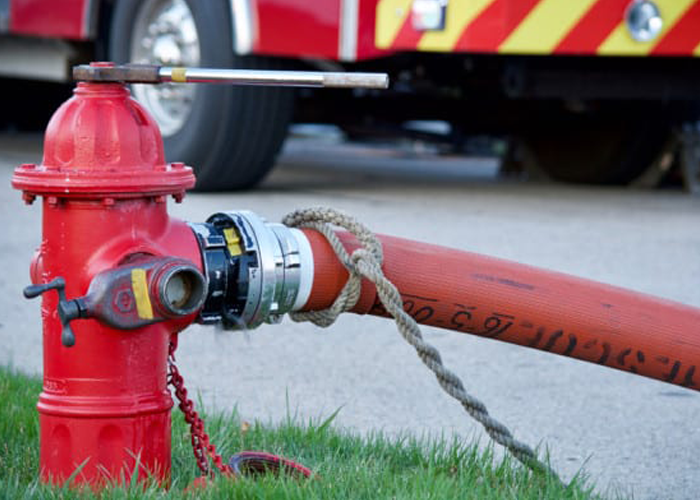
Every NFPA 291 flow test ends with a written flow test report: test and flow hydrant locations, time, pressures, GPM and the calculated flow curve, ready for water supply analysis by your engineer.
What your report includes:
- Hydrant locations, main size and test time
- Static, residual and pitot readings
- Available flow at 20 psi residual
Hydrant Classification and Color Coding
NFPA 291 groups hydrants by rated flow: Class AA (1,500 GPM or more, light blue), Class A (1,000 to 1,499 GPM, green), Class B (500 to 999 GPM, orange) and Class C (under 500 GPM, red). We can paint the caps to match.
Why classification matters:
- Firefighters see available flow at a glance
- Keeps private hydrants consistent with local practice
- Flags weak hydrants for repair or follow-up
CASE STUDY: ADVANCED FIRE PROTECTION SYSTEMS FIRE LINE INSTALLATION
Service: Fire Line System Installation
A commercial establishment wanted to upgrade its safety with an advanced fire line protection system. After weighing several firms, they selected Seadmok Water Construction LLC for the work, which demanded careful planning and precise execution. .
What we did:
- Saw cut both asphalt and concrete to open the path.
- Excavated a 4 ft trench from the building to the fire line.
- Backfilled the trench with dirt.
- Compacted the top with CR6 for a solid finish.
- Completed permanent asphalt restoration.

CASE STUDY: CAPITOL HEIGHTS FIRE HYDRANT REPLACEMENTS
Service: Fire Hydrant Replacement
A local business in Capitol Heights, Maryland needed three aging 6" fire hydrants replaced. After consulting several firms, they chose Seadmok Water Construction LLC for a competitive proposal and a clear plan. Despite challenging existing infrastructure, the crew executed the replacement cleanly.
What we did:
- Carefully excavated to remove the old 6" fire hydrants.
- Installed three new 6" fire hydrants.
- Backfilled to a 2 ft depth with Class 57 gravel over the weep and drain holes.
- Stabilized and seeded the area, restoring the landscape.
CASE STUDY: GEORGIA GRACE CAFE FIRE LINE INSTALLATION
Service: Fire Hydrant and Fire Line Installation
A client needed a fire line installed for her new restaurant in old Ellicott City, where she had acquired and gutted two side by side buildings. She collected three quotes: the first at $77K, the second at $64K, and Seadmok at $52K. Old Ellicott City is known for heavy rock, which pushed every bidding contractor to raise pricing. Seadmok won the contract and completed the entire project in 27 hours straight. Georgia Grace Cafe is now open for business.
What we did:
- Abandoned two domestic water house connections.
- Installed a 6x4 tee on a 6" water main.
- Installed a 4" valve.
- Cored a 2 ft thick wall.
- Ran a 4" ductile iron pipe (DIP) line into the building.
- Performed a pressure test on the tee connection.
- Backfilled and stabilized the trench.
- Completed final asphalt restoration.
Frequently Asked Questions
A fire hydrant flow test measures how much water a hydrant and the main behind it can deliver. We record static pressure, residual pressure and flow in gallons per minute, then calculate available fire flow following NFPA 291.
Areas We Serve
Baltimore City, MD
Howard County
Prince George's County, MD
Montgomery County, MD
Anne Arundel County
Read the Seadmok Blog

What Causes Low Water Pressure Across a Whole Building?
Low water pressure is a common issue that can affect the functionality and efficiency of a household’s plumbing system. Seadmok Water provides system upgrades and maintenance to prevent future low water pressure issues.

Signs of a Failing Sewer Lateral: What Maryland Homeowners Should Watch For?
Low water pressure is a common issue that can affect the functionality and efficiency of a household’s plumbing system. Seadmok Water provides system upgrades and maintenance to prevent future low water pressure issues.
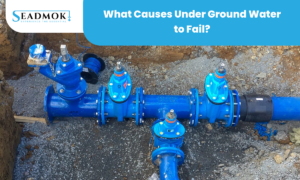
What Causes Underground Water Valves to Fail?
Low water pressure is a common issue that can affect the functionality and efficiency of a household’s plumbing system. Seadmok Water provides system upgrades and maintenance to prevent future low water pressure issues.

How to Avoid Water Connection Problems with Proper Maintenance?
Low water pressure is a common issue that can affect the functionality and efficiency of a household’s plumbing system. Seadmok Water provides system upgrades and maintenance to prevent future low water pressure issues.

What to Do If You Have a Main Water Line Leak:A Homeowner’s Guide
Low water pressure is a common issue that can affect the functionality and efficiency of a household’s plumbing system. Seadmok Water provides system upgrades and maintenance to prevent future low water pressure issues.

Water House Connection in Baltimore City: In-Depth System Guide
Low water pressure is a common issue that can affect the functionality and efficiency of a household’s plumbing system. Seadmok Water provides system upgrades and maintenance to prevent future low water pressure issues.