

How Does City Water Get to Your House?
What you need to know
- City water starts in a river, reservoir, or aquifer, then a water treatment plant cleans it through coagulation, flocculation, sedimentation, filtration, and disinfection, according to the CDC.
- Pumps and elevated water towers push treated water through the municipal water distribution system, a network of underground water mains. The U.S. has more than 2 million miles of these pipes, per ASCE's 2025 Infrastructure Report Card.
- A smaller pipe called the water service line carries water from the main to your house.
- In WSSC Water territory, the utility owns the service line up to the property line, and the property owner owns the rest.
- A water meter records every gallon you use, and shut-off valves let you or the utility stop the flow.
- Most of Howard County's public water originates in Baltimore City, while North Laurel gets its supply from WSSC Water.
How does city water get to your house? It travels from a natural source to a treatment plant, through pressurized water mains under the street, and finally through one service line that enters your home. That trip can cover many miles before you turn on a faucet.
We install and replace water service lines across Maryland, so we see the stretch most guides skip: the last few yards between the street and your foundation wall. Honestly, that short pipe is where most of the problems a homeowner pays for actually show up.
Quick answer: City water reaches your house in five stages:
- Source: a utility draws raw water from a river, reservoir, or underground aquifer.
- Treatment: a water treatment plant removes dirt and germs, then adds a small amount of disinfectant.
- Storage and pumping: pumps and water towers hold the treated water and keep it under pressure.
- Distribution: large water mains carry it under the streets to every neighborhood.
- Service connection: a service line, water meter, and shut-off valve bring it into your home.
Where Does Tap Water Come From Before It Reaches Your City?
Tap water comes from either surface water (rivers, lakes, and reservoirs) or groundwater pumped up from aquifers. Most large city systems rely mainly on surface water, which is why reservoirs matter so much.
Here's a local example. Howard County is a "consecutive water system," which means it buys treated water instead of treating its own.
According to Howard County's Department of Public Works, most county customers get a municipal water supply that originates in Baltimore City. The North Laurel area east of Interstate 95 is supplied by WSSC Water.
Think of it like a corner store that sells bottled water. The store handles delivery to your door, but a bottler somewhere else fills every bottle.
If you want to know what's in your supply, our guide on how to determine safe drinking water in Maryland walks through the annual water quality report.
What Happens at the Water Treatment Plant Before Water Heads to Your Home?
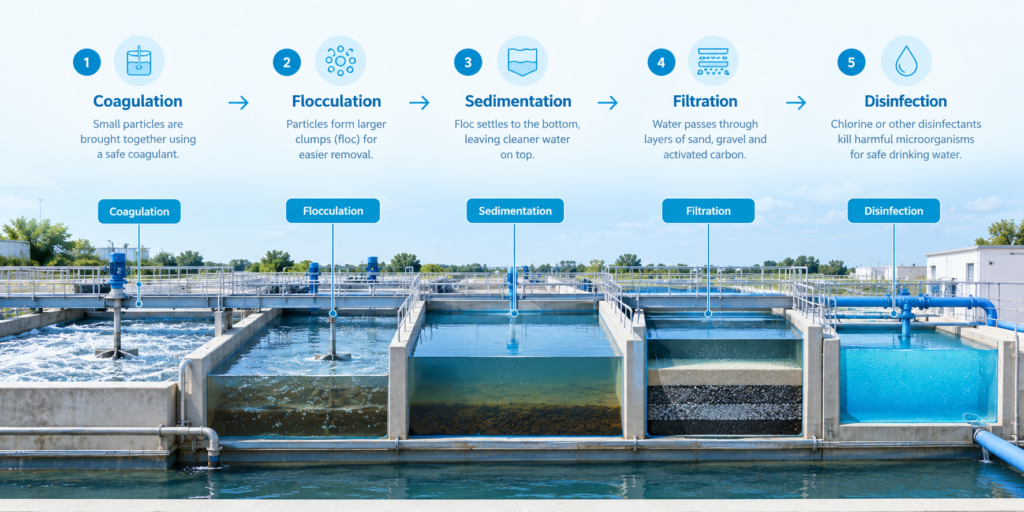
A water treatment plant is the facility that turns raw river or reservoir water into potable water (water that's safe to drink). The CDC lists five common treatment steps used by community systems:
- Coagulation: chemicals are added so tiny dirt particles stick together.
- Flocculation: gentle mixing builds those clumps into larger, heavier particles called flocs.
- Sedimentation: the heavy flocs settle to the bottom of a basin.
- Filtration: the clear water passes through filters such as sand, gravel, and charcoal.
- Disinfection: chlorine, chloramine, UV light, or ozone kills remaining germs.
Picture a shaken snow globe. Sedimentation is the moment you set it down and the flakes drift to the bottom, leaving clear water on top.
The CDC notes that plants leave a low level of disinfectant in the water as it leaves, which protects it during the long ride through the pipes. Many plants also adjust pH and add fluoride after disinfection. Water from lakes and rivers usually needs more treatment than groundwater.
How Does the Municipal Water Distribution System Move Water Across Town?
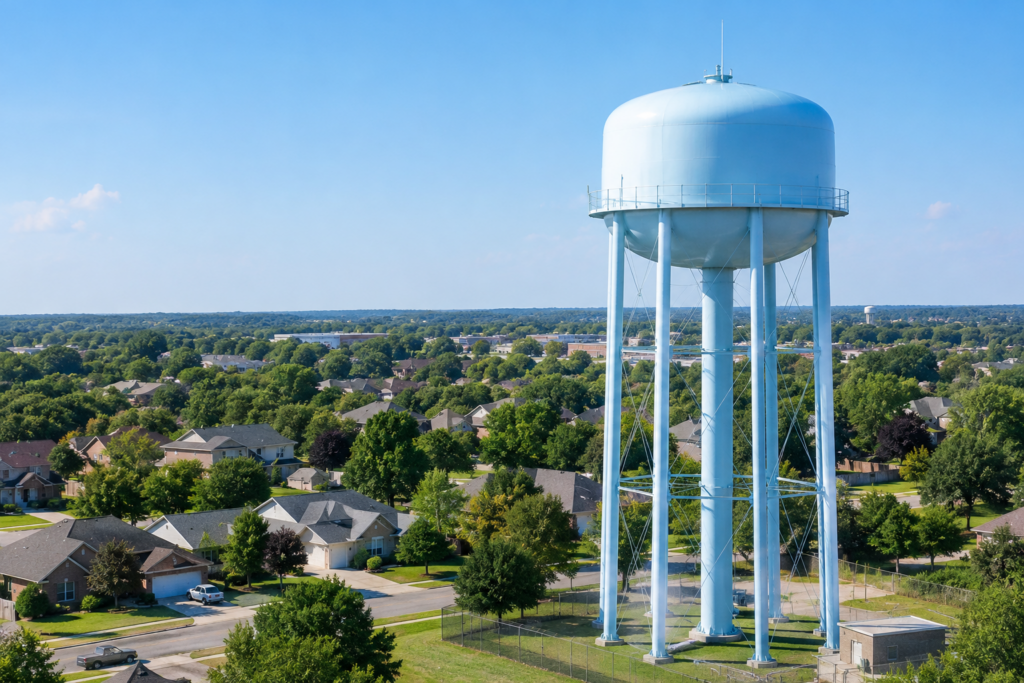
The municipal water distribution system is the network of pumps, storage tanks, and underground water mains that carries treated water from the plant to every street. It works a lot like your circulatory system: big transmission mains are the arteries, neighborhood mains are smaller vessels, and the service line to your house is a capillary.
Pressure is what keeps the water moving. Pumps push water into the system, and water towers built on high ground let gravity do the rest.
The USGS explains that gravity alone can carry water from an elevated tower all the way to the last house in a subdivision.
That stored height also buys time in an emergency. The City of Wenatchee, Washington, told local station KPQ that its elevated tanks can keep homes supplied for up to 24 hours if a power outage knocks out the pumps.
Water pressure isn't identical everywhere, though. Homes far from pumping stations or high on a hill can see weaker flow. If that sounds familiar, our guide to low water pressure covers the usual causes.
The pipes themselves are aging. ASCE's 2025 Infrastructure Report Card gave American drinking water a C minus and estimates roughly 240,000 water main breaks happen each year.
When a main under your street fails, the utility handles it, and our water main break repair process explains what that work looks like.
How Does Water Get From the Main to Your House?
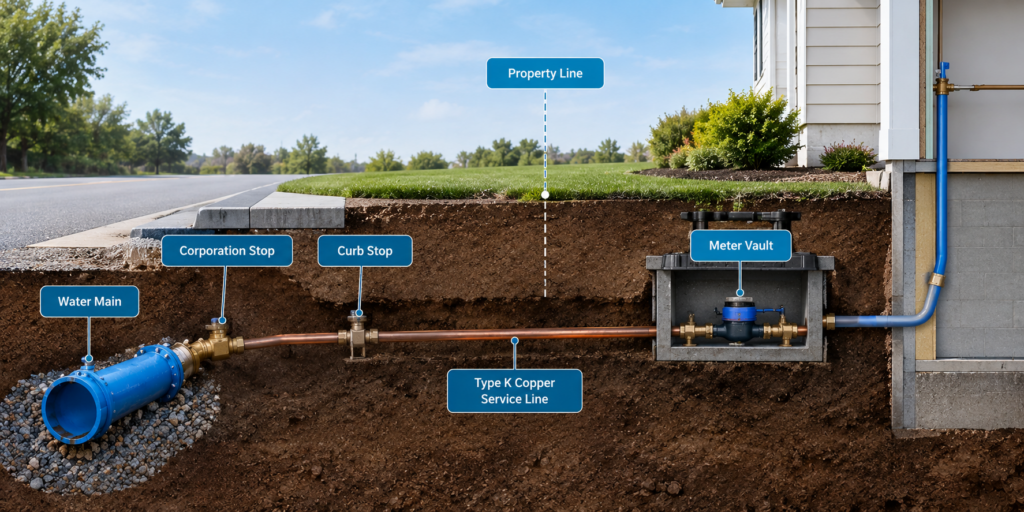
The water service line from main to house is a small underground pipe that branches off the public water main and runs into your building. It has a few key parts:
- Tap and corporation stop: the fitting where the service line connects to the water main.
- Curb stop: a buried valve near the property line that the utility uses to shut off your supply.
- Service line: the pipe itself. In Maryland we typically run Type K copper, while older homes may still have galvanized steel or even lead.
- Meter: sometimes in an outdoor meter vault, sometimes in the basement.
Who owns that pipe? WSSC Water states that it's responsible for the section from the main to the property line, and the customer owns the section from the property line into the home.
Rules vary by utility, so our breakdown of who is responsible for the water line from the street to your house in Maryland covers Baltimore City, Howard County, and the rest.
Here's what that looks like on a real job. For one homeowner, we installed the private side first, from a new meter vault into the house on day one. On day two we connected the public side from the main to the vault. He later told us our public-side price was half of the competing bid.
Pipe material matters more than most people expect, so we compare the options in Type K copper vs. HDPE vs. PEX.
What Do the Water Meter and Shut-Off Valve Do?
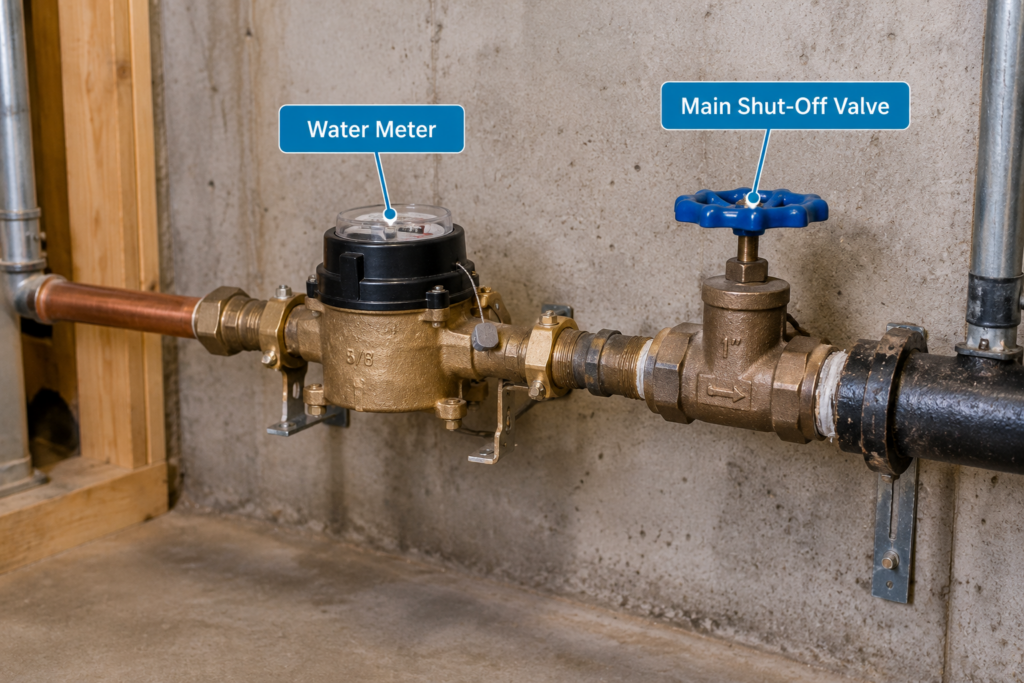
The water meter measures every gallon that enters your property, and your bill is based on that reading. The main shut-off valve, usually in a basement, garage, or utility room, stops water to the entire house when you close it.
There are normally two valves in play. The curb stop near the street belongs to the utility, while the one inside your home is yours to use in an emergency.
Find it before a pipe bursts. Our guide on how to locate your main water shut-off valve shows where to look.
Your meter doubles as a leak detector. Turn off every fixture and watch the dial; if it keeps moving, water is escaping somewhere. Learn how to read a water meter to run this test yourself.
Where Does Water Go Once It Enters Your Home?
Once inside, the main line splits. Cold water lines branch straight to sinks, toilets, and appliances, while another line feeds the water heater, which sends hot water out through a parallel set of pipes. Most fixtures also have their own small shut-off valve.
One honest caveat: our crews work on the underground side, from the main to the point where the line enters your building. Interior pipes, fixtures, and water heaters are a licensed plumber's job, and we'll tell you if that's where your problem is.
Who Owns Each Part of the City Water System?
Knowing how water is delivered to homes also means knowing who owns each piece. Ownership usually changes at the property line or the meter. This table shows the typical split, though you should always confirm the details with your own utility.
| Stage | What Happens | Who Typically Owns It | Common Problems |
|---|---|---|---|
| Source | Raw water is drawn from a river, reservoir, or aquifer | Utility or regional supplier | Drought, runoff contamination |
| Treatment plant | Water is cleaned and disinfected | Utility | Rare for homeowners to notice |
| Water mains | Pressurized pipes carry water under streets | Utility | Breaks, aging pipe, low pressure |
| Service line, main to property line | Branch pipe leaves the main | Utility (WSSC Water model) | Leaks, lead or galvanized pipe |
| Service line, property line to house | Pipe crosses your yard into the building | Property owner | Leaks, corrosion, pressure loss |
| Meter and shut-off valve | Usage is measured and flow can be stopped | Varies by utility | Stuck valves, failing meters |
When Does a Property Need Water Service Line Installation or Replacement?
Water service line installation is needed when you build new, switch from a private well to public water, replace a failing or lead line, or add a dedicated fire line. Watch for these warning signs:
- Soggy patches in the yard: pooling water over the line's path often means a leak.
- A sudden pressure drop: especially when neighbors aren't affected.
- Rusty or discolored water: showing up with no change in your habits.
We cover more in 7 warning signs your water service line is failing.
Lead lines are getting national attention. The EPA published its Lead and Copper Rule Improvements in October 2024, which push utilities to inventory service lines and speed up lead line replacement. Our page on lead service line replacement in Maryland explains what that means for property owners.
Water can leave the treatment plant meeting every federal standard and still pick up problems on the last stretch. An old lead or galvanized service line affects water after it leaves the public system. Read your utility's annual Consumer Confidence Report and find out what your own pipe is made of.
Bigger buildings follow the same path, just with larger pipe. For Georgia Grace Café in Old Ellicott City, we tapped a 6 inch water main with a 6x4 tee, set a 4 inch valve, cored a 2 foot thick wall, and ran 4 inch ductile iron pipe into the building. Despite heavy rock, the crew finished in 27 straight hours.
If you're planning a new connection or replacing an old one, our water house connection service handles the tap, the service line, the meter, and coordination with your utility.
The Bottom Line on How City Water Gets to Your House
City water follows a simple chain: source, treatment plant, pressurized water mains, and finally your own service line, meter, and shut-off valve. The utility handles most of that journey. The last stretch, from the property line to your wall, is usually yours.
That's the part worth understanding before something goes wrong. Know where your shut-off valve is, know what your service line is made of, and know where your utility's responsibility ends.
If your line is old, leaking, or you're connecting a property to public water for the first time, schedule a consultation with our team.
For the full process, see our complete guide to connecting your home or business to public water.
The utility moves water from the source to the main under your street. The service line from the property line to your wall is usually your responsibility, so know your shut-off valve, your pipe material, and where your utility's ownership ends.
About the author: Sidney Sobgor is the CEO of Seadmok Water Construction LLC in Columbia, Maryland, and has worked in the water industry for over 10 years. His team installs water house connections, water mains, valves, and sewer laterals across Howard County, Baltimore City, Montgomery County, Prince George's County, and Anne Arundel County.
Frequently Asked Questions
Does city water use gravity or pumps to reach your house?
Most systems use both. Pumps at the treatment plant and booster stations push water into the mains and up into elevated storage tanks. From there, gravity creates steady pressure that carries water downhill to homes, which is why towers sit on high ground and why many neighborhoods keep their water briefly during a power outage.
Who is responsible for the water line from the street to your house?
It depends on your utility. In WSSC Water territory, the utility owns the pipe from the main to the property line, and the owner is responsible from the property line into the home. Some cities draw the line at the meter instead, so check with your utility before any digging. That boundary decides who pays for a leak.
Why is city water pressure low in some homes?
Low pressure usually starts in one of three places: the public system, the service line, or interior plumbing. Distance from pumping stations and higher elevation can weaken pressure on a whole street. If only one house is affected, a leaking, corroded, or undersized service line is a common culprit, and a gauge on an outdoor spigot helps narrow it down.
How long does it take to install a new water service line?
Many residential installs take one to two days of field work once permits and utility approvals are in place. On one Maryland job, we finished the private side on day one and the public connection on day two. Commercial work varies more; our Georgia Grace Café fire line took 27 straight hours. Permits often take longer than digging.
Is city water safe to drink straight from the tap?
In most American cities, yes. Public systems must meet Safe Drinking Water Act standards, and every community supplier publishes an annual Consumer Confidence Report. The bigger risk usually sits closer to home, since an old lead or galvanized service line can affect water after it leaves the public system. Read your report and know your pipe material.
What happens to the water supply if the city loses power?
Elevated water towers and storage tanks keep supplying homes by gravity for a period after pumps stop. The City of Wenatchee, Washington, says its tanks can cover up to 24 hours. How long your area lasts depends on storage size, demand, and backup generators at pumping stations. Your utility's emergency page is the best place to check local details.